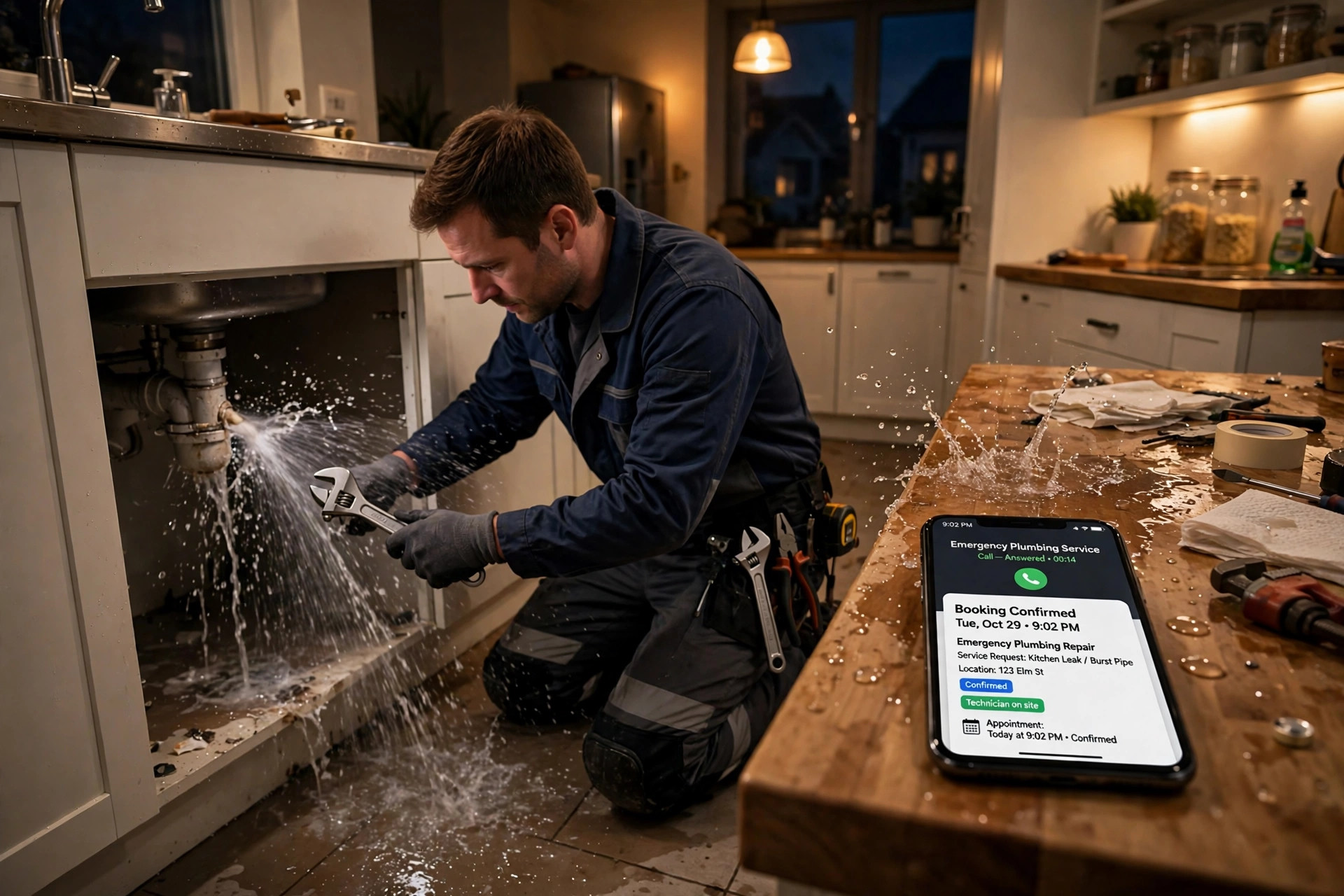
If you run a plumbing shop, an AI receptionist for plumbers is not about replacing your voice on the phone — it's about what happens at 9 PM when a kitchen is flooding and you're already under somebody else's sink. That caller isn't browsing. She has water on the floor, a shutoff she can't find, and a list of plumbers open on her phone. Whoever answers first — calmly, with real questions and a real time — gets the job. Whoever sends her to voicemail gets forgotten before the water stops.
Plumbing emergencies don't wait for business hours
Plumbing is the trade where timing is the product. A dripping faucet can wait until Tuesday; a burst pipe, a backed-up sewer, and a dead water heater on a cold morning cannot. Those calls come when they come — early, late, weekends, holidays — and they come with urgency attached. You can't schedule an emergency around office hours, and you can't answer one properly with wet hands, a wrench in your grip, and a homeowner standing over you asking how bad it is. That's not a staffing failure. It's the nature of the work: you're paid to be where the problem is, which is exactly where you can't run an office from.
What she actually does: triage, quote and book — not just take a message
Alice doesn't just take a name and promise a callback. Working as an AI that quotes jobs, she triages the call the way an experienced dispatcher would: what's leaking or stopped, where it is, whether the water is shut off, who lives in the house, and how fast someone needs to be there. From your own rates, your emergency callout rules, and your service area, she gives the caller an honest next step — tonight, first thing, or a booked window — and if the job fits, she puts it on your calendar and sends the confirmation right then. The customer hears certainty, not a beep. You get a booked job with the details already collected, not a voicemail you have to decode at midnight.
After-hours booking is where the emergency work lives
After-hours booking is where plumbing companies quietly make — or lose — their week. Evenings are when families get home and discover the problem, and weekends are when a small leak becomes a floor, a ceiling, and a bigger repair. Those callers are also the least patient shoppers you'll ever meet, because the clock is part of the damage. An AI receptionist for plumbers covers that window without asking you to hire a night dispatcher or sleep with the phone on your pillow: the 9 PM burst pipe is answered at 9:00, triaged by 9:01, and booked by 9:02, with the address, the shutoff status, and the access notes waiting for whoever rolls. You still decide the on-call rules — Alice just makes sure the rules actually get applied when the call comes in.
Start with the missed call audit
Before you change anything, run a missed call audit on your own shop. It counts the calls that rang out last month, separates the evenings and weekends, and prices them against your average job — your numbers, not a national average somebody invented. For most plumbers the surprise isn't the daytime count; it's how many emergency-ready callers arrived after the shop went dark. Run the audit, watch Alice answer, quote and book live, and then decide the only question that matters here: would a front desk that never sleeps book more jobs for your crew than your voicemail does? If the audit says the calls are there, the answer is already on the page.