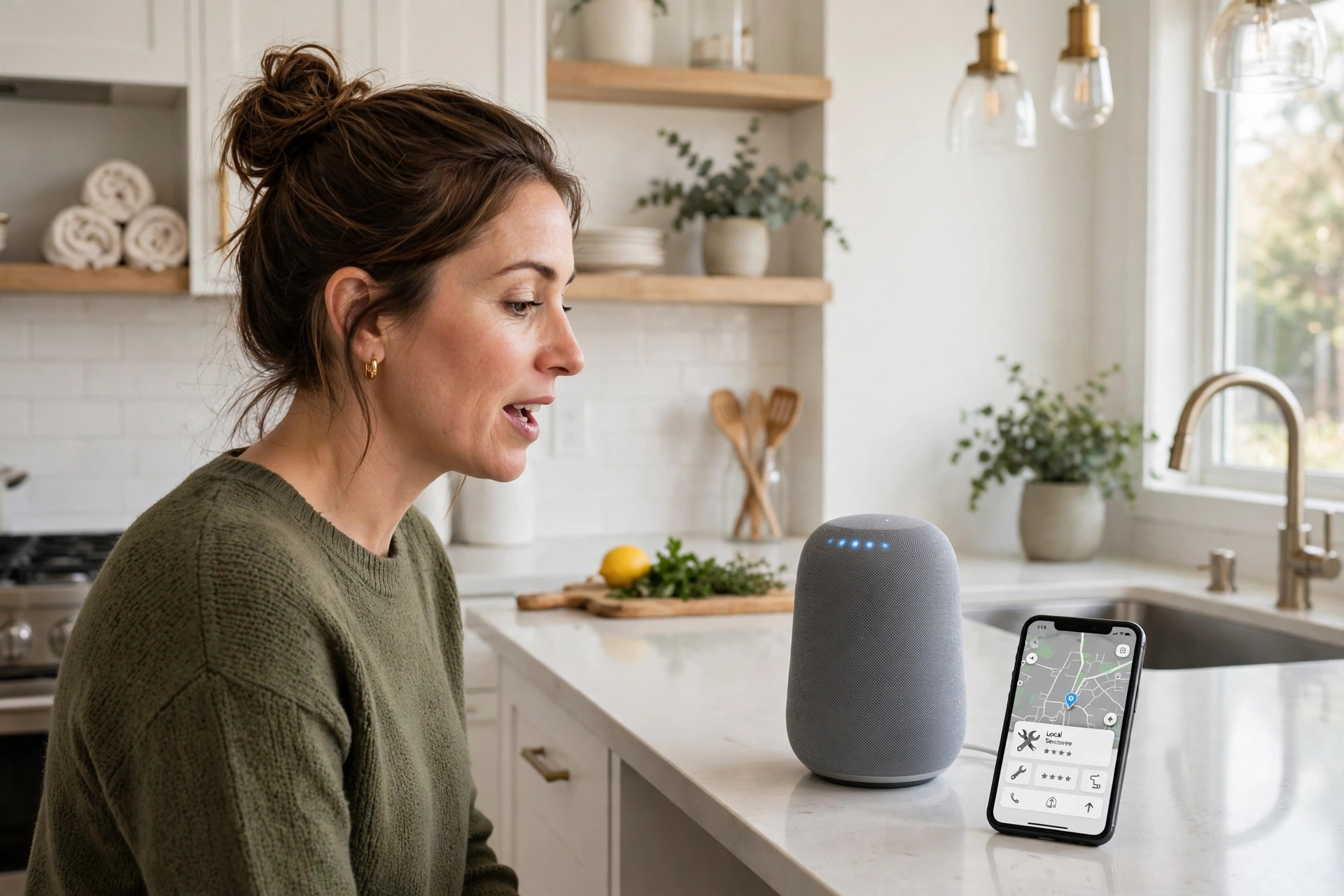
“How do I get my business on Alexa?” is the question owners ask after a customer tells them how they found a competitor: not by typing, but by asking out loud. The sink is leaking, their hands are full, and they say, “Alexa, find me a plumber near me” — or they ask Siri in the truck, Google Assistant in the kitchen, or an AI chat box who they should hire. One name comes back. If it isn't yours, the job conversation starts without you.
Where the spoken answer actually comes from
A voice assistant doesn't invent its answer, and it doesn't browse the whole web in that moment. It reads from source listings — business profiles, directories, maps data, and websites it can crawl — and picks the business whose information is clear, consistent, and close. That means the real question behind “get my business on Alexa” isn't a trick or a setting hidden in the speaker. It's whether your business exists, correctly, in the places those answers are built from.
What a voice listing really is
A voice search listing for local business is not one listing at all. It's the same business told the same way in several places at once: your Google Business Profile claimed and verified, your name, phone, and service area matching across directories, and a website that plainly says what you do and where you do it. When those sources disagree — an old number here, a different name there, no service area anywhere — the assistant has nothing solid to read out, so it reads someone else.
The AI chat layer
The same discipline now decides who shows up in written answers too. Owners who want to get cited by ChatGPT, Gemini, or Bing are really asking for the same thing: information about their business that is consistent and crawlable enough for an AI answer to trust and repeat. There's no submission button that puts you in the answer. There is setup work — accurate profiles, synced listings, and pages that state your services in plain language — that makes your business eligible to be cited at all.
Check before you fix
Start by seeing yourself the way those systems do. An AI visibility report walks the signals an answer is built from: Is your profile verified? Do your listings agree? Can a crawler read what you offer and where? Where does the trail go cold? That check shows you the gaps in order, so the fix is a list of concrete tasks — claim this, correct that, sync the rest — instead of a vague worry that you're invisible somewhere.
What signing up actually starts
Here is the honest version, because this is where the promises usually get slippery. An Alice Visibility signup triggers the setup, verification, and sync of your listings across those sources. That work makes your business indexable and eligible to be found when a customer asks out loud or asks an AI chat box. Nobody honest can guarantee a ranking, a top spot, or that an assistant will say your name every time — and we won't promise one. What we can do is the real work that puts you in the pool of answers, instead of outside it.
Being found is only half of it
The other half is what happens in the next thirty seconds. The assistant names a business and offers to call it. If that call rings out, the customer asks for the next name. Alice was built for both halves: the visibility setup that makes you eligible to be found, and the answering, quoting, and booking that turns being found into a booked job.