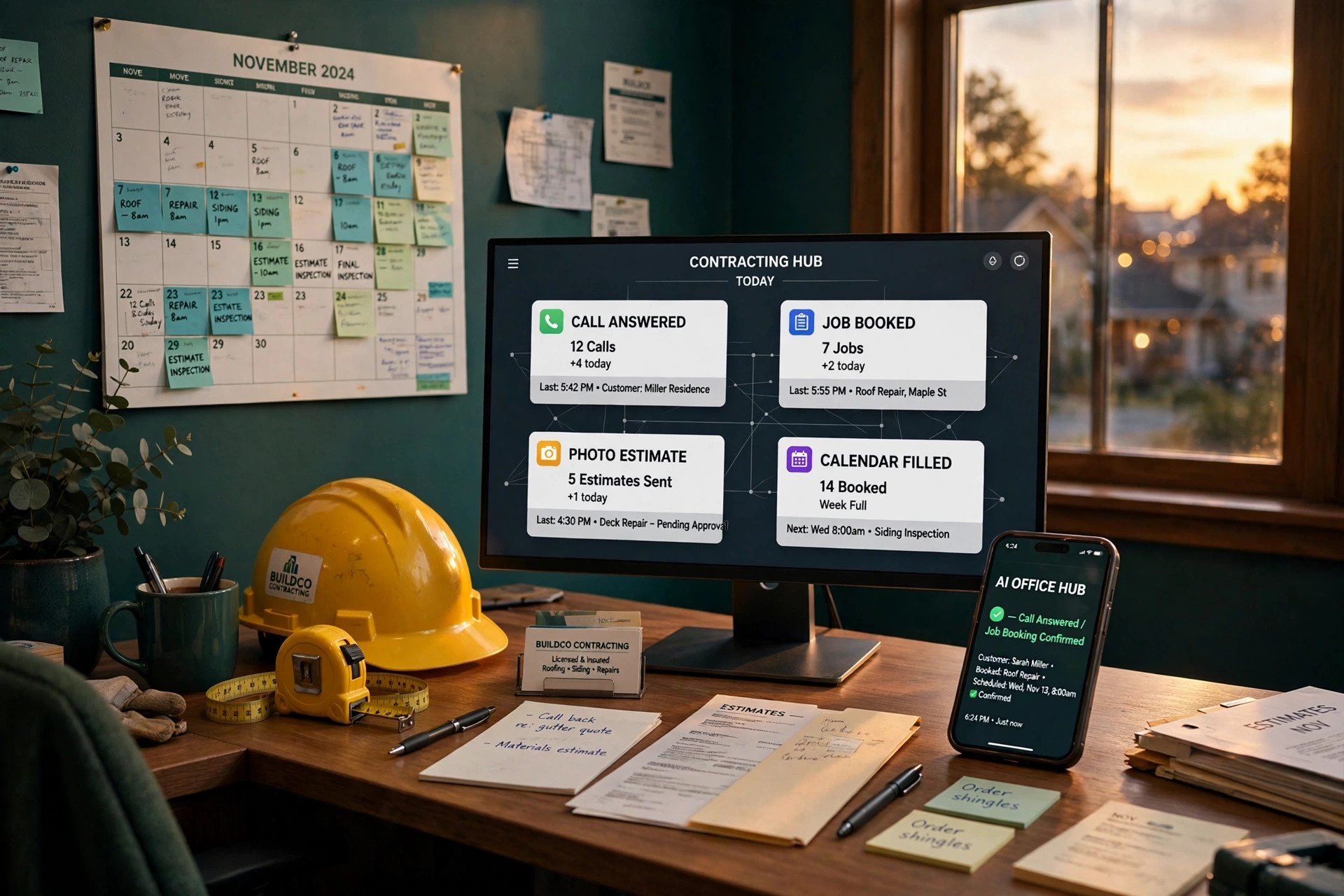
An AI office hub is not a piece of software you buy and a desk you staff. It is the whole front office of a contracting business — the phone answered, the job booked, the estimate quoted, the calendar filled — running as one system while the owner is out on a job. The contractor does not hire a receptionist, a dispatcher, and an estimator. The office is the hub, and it works the hours the owner cannot.
One hub, four jobs
Everything the front office used to do in four places now happens in one. The hub answers the call in the customer's language, books the job straight into the calendar, quotes from a photo or a short video, and keeps the record — who called, what they need, when they are booked — so nothing lives in a voicemail nobody checks. A virtual office for contractors built this way does not replace the owner; it replaces the pile of missed calls, paper message slips, and callbacks that never happened. The customer gets an answer in seconds; the owner gets a booked job instead of a mystery number on the missed-calls list.
Why the hub beats the pile
A contractor's hands are the reason the phone goes unanswered: a wrench in one hand, a ladder underfoot, a customer asking about the job you are already doing. ServiceTitan-reported figures put unanswered home-service calls at about 41% on weekends, Drift and Salesloft's 2024 report found about 39% of buyer conversations happen outside 9-to-5 hours, and CallRail's 2025 survey found 82% of consumers call a competitor after a business doesn't answer. A missed call audit turns that pattern into a number for your own business — how many calls came in, how many went unanswered, and what those jobs were worth.
After hours is where the hub earns its keep
After-hours booking is the quietest money in a contracting business. The burst pipe at 9 p.m., the furnace that quit on a Sunday, the homeowner with a free evening to get three quotes — those calls do not wait for Monday morning, and they do not leave voicemails. An AI office hub takes an after-hours booking the same way it takes a Tuesday morning call: name, job, address, time on the calendar. That is how you book more jobs without working more hours — the hub takes the calls that used to evaporate, and the owner wakes up to a calendar filled overnight — never miss a job is not a slogan here; it is the job description of the hub itself. And when the customer sends a photo of the damage, the AI that quotes jobs turns it into an estimate the same hour, while the customer is still deciding who to hire.
What it costs, in plain numbers
The honest comparison is against the alternatives, and the published numbers are already on the table. A live answering service runs $180–$1,160 per 100 calls, median $444 (NextPhone AI Receptionist Price Index), and a full-time receptionist runs about $3,170 a month in wages. Alice's own pricing, in the current model: the hub at Founding $49 a month, and the phone line on a 7-day free trial with 10 calls included, then $11.99 a week for up to 20 calls a week, counted by the second — with Spanish included and no per-call surcharge. The hub is not a cheaper version of a person at a desk. It is a different thing: a system that answers, quotes, and books at any hour, for a flat number you can read before you buy.
Start with the audit, not a purchase
The right first step is not buying a hub — it is finding out what your current office is costing you. Run the free missed call audit on your own number and see the calls you never knew you missed, priced in jobs. If the number is small, you have lost nothing but two minutes. If it is large, you will know exactly what an AI office for contractors has to beat — and the hub has to keep beating it every single day, one answered call at a time.