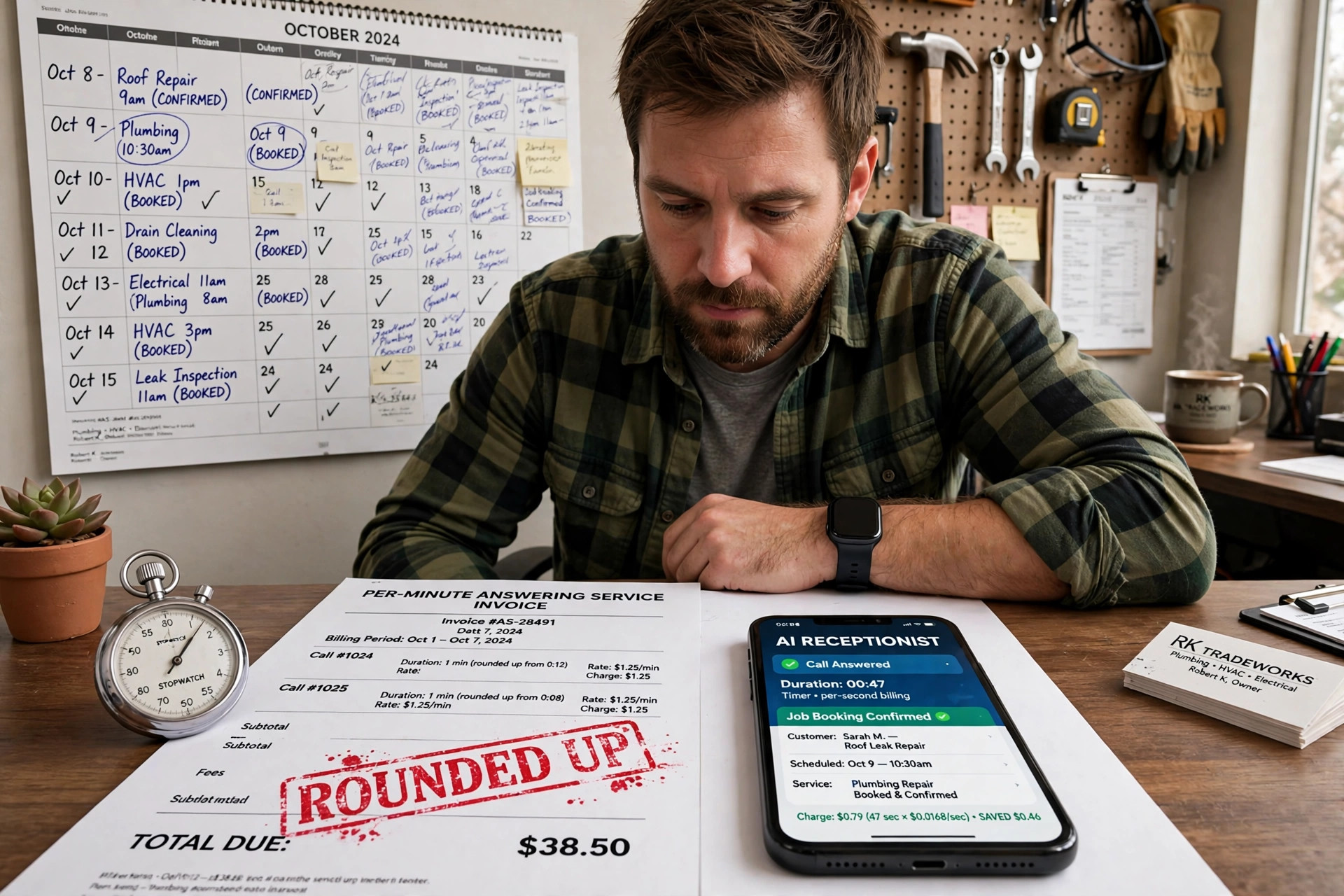
An ai receptionist that doesn't round up your calls sounds like a small billing detail. It is not. On a per-minute plan, rounding is where the bill quietly grows: a 12-second “are you open Saturday?” is billed as a full minute, a 61-second booking is billed as two, and a month of short, ordinary calls is billed as if every one of them ran long. They bill the minute. We bill the second. This edition is about reading that one line on your invoice — because it decides what the answer actually costs.
They bill the minute: how rounding inflates the bill
Per-minute billing with round-up is the standard structure behind most answering prices. The published numbers show what it adds up to: on prices read November 2, 2026, a live answering service runs $180–$1,160 for 100 calls a month, median $444 (NextPhone AI Receptionist Price Index), and metered AI plans run a median of $149 a month at 100 calls and $362 at 300 calls on the same index. Inside every one of those totals, each call was rounded up to the next full minute before it was priced. A wrong number, a quick directions call, a 20-second “yes, Thursday works” — all billed as 60 seconds. The shorter your typical call, the more of your bill is time nobody used. That is why the honest ai receptionist cost question is never just the rate — it is the rate plus the rounding rule underneath it.
We bill the second: how Alice counts instead
Alice's Second Line credits tick by the second — one credit is one second of call time, and nothing rounds up. A 47-second call uses 47 seconds. A 12-second call uses 12. And the phone offer itself is not a per-minute meter at all: claiming your business number starts a 7-day free trial with 10 calls included, then Alice Phone is $11.99 a week for up to 20 calls a week. If your line rings past that, an optional More Calls tile adds 20 more calls a week for $9.99 a week — a menu you choose from, published in advance, not a meter running behind your back. Spanish answering is included at no per-call surcharge. The week costs what the week costs, and the seconds are counted as seconds.
The answer matters more than the arithmetic
Fair counting would matter less if the service stopped at taking a message. Alice does not stop there. She answers from your own business information, she is an AI that quotes jobs from a customer's photo priced only from your rates, and she books the job into your calendar — after-hours booking included, evenings and weekends. That after-hours piece is where the real money sits: in Drift and Salesloft's 2024 conversational-data report, about 39% of buyer conversations happen outside 9-to-5 hours, and in CallRail's 2025 survey, 82% of consumers said they will call a competitor after a business doesn't answer. A rounded-up minute is an annoyance. An unanswered call is a lost job.
Check your own bill before you switch anything
Pull last month's answering invoice and do three things. First, find the rounding rule — if it is not printed, ask for it in writing. Second, count your short calls: every call under a minute that was billed as a minute is money paid for silence. Third, run the free missed call audit with your own numbers and see what the calls you never answered are costing next to the ones you overpaid to answer. Then compare totals, not stickers — so you never miss a job to a ringing pocket, and book more jobs without paying for minutes nobody used.