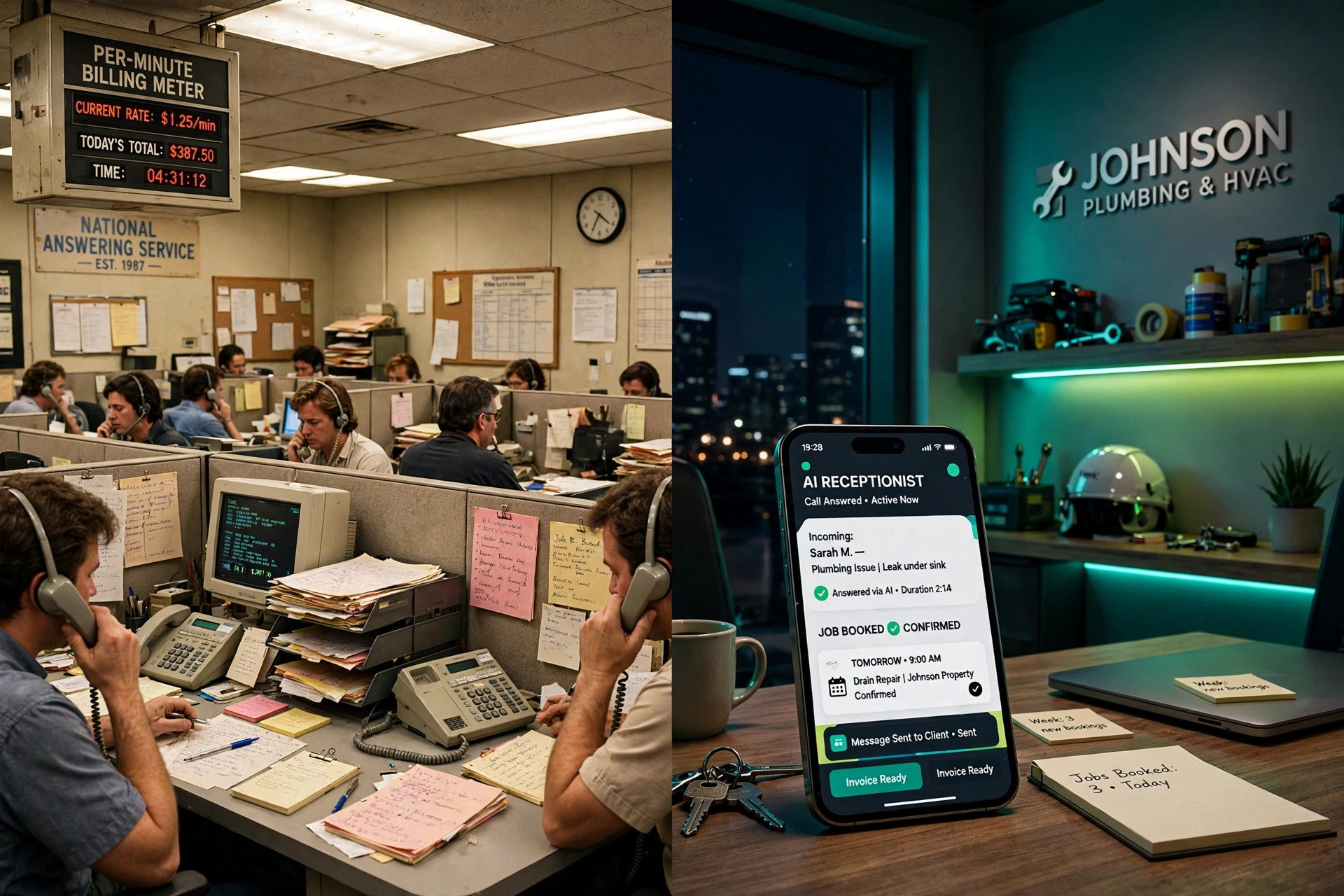
If you are pricing coverage for your phones, the real question behind AI receptionist vs answering service is not which one answers — both answer. It is what happens after the ring, and what you pay for it. One sells you a message. The other is built to finish the job: ask the questions, quote your price, and put the work on your calendar. Here is the side-by-side, with the numbers in the open.
What an answering service sells you
A live answering service is a room of operators with headsets selling a taken message: a name, a number, a note relayed to you later. The meter is the business model. On published prices read November 2, 2026, live answering runs $180–$1,160 for 100 calls a month, median $444 (NextPhone AI Receptionist Price Index) — billed by the minute, usually rounded up, so a 20-second call bills as a full minute. That answering service cost buys a human voice and a message slip. It does not book the job or quote it, and after-hours is where the meter bites hardest. The other human option is no cheaper: a full-time receptionist runs about $3,170 a month in wages alone.
What an AI receptionist does after the ring
An AI receptionist answers on the first ring, every time, in your business name — and then she works the call the way your office would. What is the problem? Where is it? How urgent is it? Then she quotes from rates you set — an AI that quotes jobs, never one that invents prices — checks your calendar, and books the visit before the caller thinks about the next company on the list. You get a summary of every call, not a stack of message slips to return between jobs. Spanish is answered in the same plan, with no bilingual surcharge. The honest limit: a long, emotional conversation is still a human's best work — there, Alice takes the details and loops you in.
The after-hours test decides it
Run both options against the calls that decide a trade business's week. Almost 4 in 10 customers reach out when your shop is closed (Drift / Salesloft conversational data, 2024), ServiceTitan-reported figures put unanswered home-service calls at about 41% on weekends, and in CallRail's 2025 survey, 82% of consumers said they will call a competitor after a business doesn't answer. That is the ground after-hours booking is won or lost on: the 9 p.m. leak, the Saturday no-heat call. An answering service takes that message — at night rates, on the meter. Alice answers it, scopes it, and books it that night, at the same flat price as a Tuesday call.
The trades math, side by side
Price 100 calls both ways. The answering service: $180–$1,160 for the month — and at the end of it you hold 100 messages you have to call back, quote, and book yourself. Alice's phone answering starts with a 7-day free trial with 10 calls included, then $11.99 a week for up to 20 calls a week — and at the end of those calls you hold booked jobs, quoted prices, and a summary in your inbox. The answering also opens the whole office — booking page, quotes, and lead inbox on the same hub, Founding at $49 a month. One honest note: claims start as pending activation — your number turns on at launch, and the demo line is live today. The full breakdown lives on the answering service cost page, with a calculator to run your own volume through both columns.
Start with the audit, not the switch
Before you change anything, run a missed call audit on your own business: count last month's unanswered calls, mark the after-hours and weekend ones, and price them against the jobs you actually sell. Your numbers, not a national average. If the count says your phone is costing you work, you know the two ways to cover it — pay by the minute for messages, or put an office on the line that finishes the call — so you never miss a job to a phone nobody could answer, and book more jobs without hiring a desk.