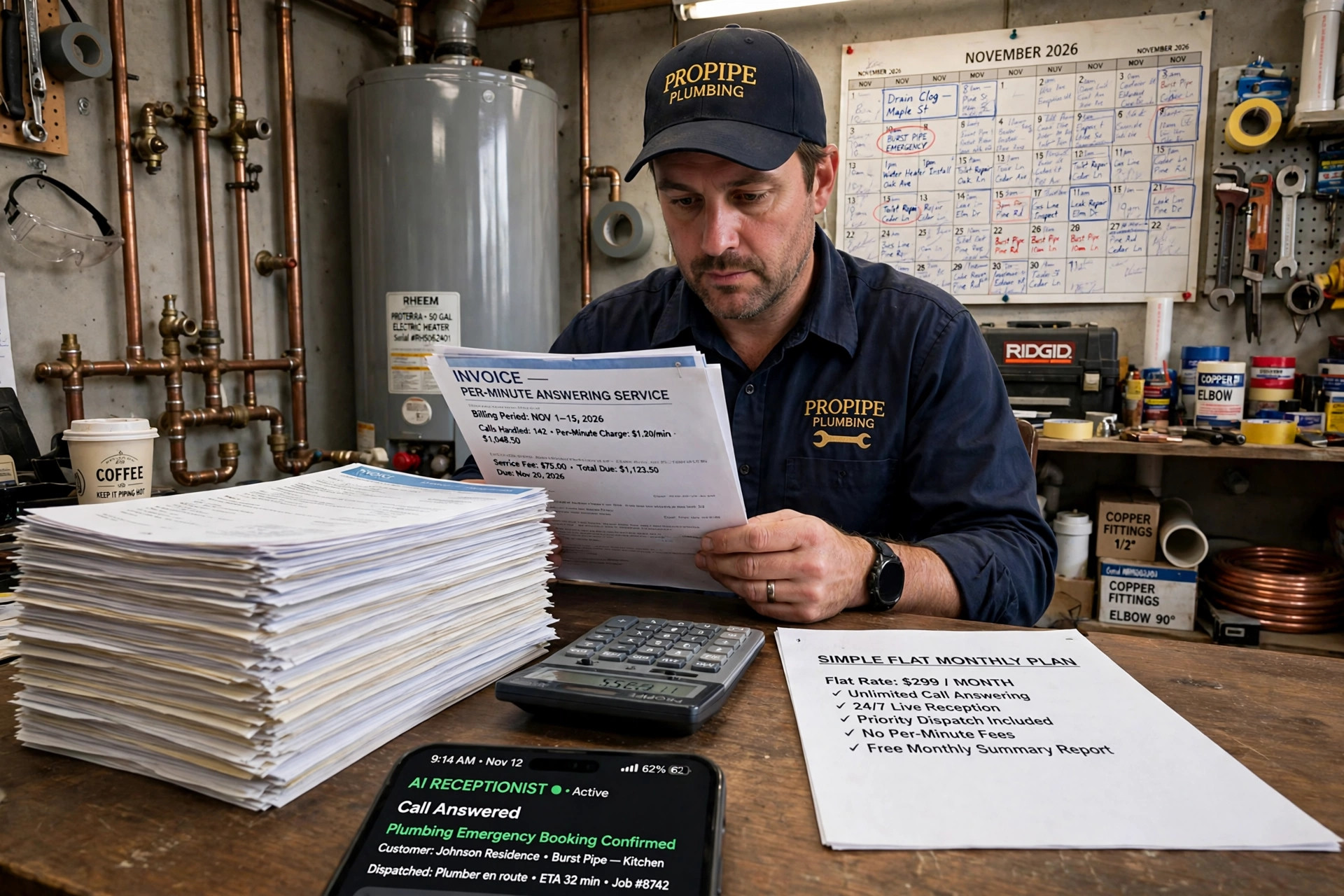
The how much does an ai receptionist for plumbers cost question sounds like a pricing question, but for a plumbing shop it is really an emergency-call question. A person calling a plumber is usually standing in water, watching a drain back up, or staring at a water heater that just quit — and they rarely call one shop. They call down the list until somebody answers, asks the right triage questions, and books the visit. This edition does that math qualitatively: the structure of the bill, the published market ranges, and what a fair price should include.
Why plumbing cost math is different
Most plumbing calls are short and urgent. The caller gives a name, an address, and the problem — burst pipe, clogged main, no hot water — then books. On a per-minute plan, that short call is rounded up and priced like a long one, and a shop that takes emergency calls makes a lot of them at the worst hours. The timing matters too. ServiceTitan-reported figures put unanswered home-service calls at about 41% on weekends, Drift and Salesloft's 2024 report found about 39% of buyer conversations happen outside 9-to-5 hours, and in CallRail's 2025 survey, 82% of consumers said they will call a competitor after a business doesn't answer. For a plumber, the cost question is never just the answering bill — it is the bill plus the jobs that rang out while you were under a sink, on a roof vent, or already on another emergency.
What the published market actually charges
Start with the ranges anyone can check. On prices read November 2, 2026, a live answering service runs $180–$1,160 for 100 calls a month, median $444 (NextPhone AI Receptionist Price Index), and metered AI plans run a median of $149 a month at 100 calls and $362 at 300 calls on the same index. A full-time in-house receptionist sits in a different league, at roughly $3,170 a month in wages — before evenings, weekends, and the emergency hours when one person cannot be at the desk. None of those numbers is a plumber-specific quote, and that is the point. Your real ai receptionist cost depends on three things the sticker never shows: whether short triage calls are rounded up to full minutes, whether a busy, wet month blows past a small call allowance, and whether the service only takes a message or actually asks the triage questions, uses AI that quotes jobs from your own rates, and books the visit into your calendar.
What a fair plumber price should include
A fair price should buy the whole job, not just the ring. The answer should greet the caller in your shop's name, ask the questions you wrote — where is the water, is the main shut off, what fixture or line is affected — and then complete the after-hours booking into your calendar, so the morning starts with visits scheduled and call summaries waiting, not a stack of message slips to return. Spanish answering should be included without a per-call surcharge. Alice is priced in the open on that basis: the office hub starts at Founding $49 a month, and Alice Phone starts with a 7-day free trial with 10 calls included, then $11.99 a week for up to 20 calls a week, counted by the second and never rounded up. If your line rings past that in a busy week, an optional More Calls tile adds 20 more calls a week for $9.99 a week — a menu published in advance, not a meter running behind your back.
Run your own numbers before you switch
Do not switch on a sticker. Pull last month's phone record and run the free missed call audit: how many calls rang out, how many landed after hours or on weekends, and what one booked emergency job is worth to your shop. Then compare totals, not headlines — the answering bill you pay now, plus the jobs the audit shows you missing. That is how a plumbing shop can never miss a job that starts as a ringing phone, and book more jobs without hiring a second desk.